

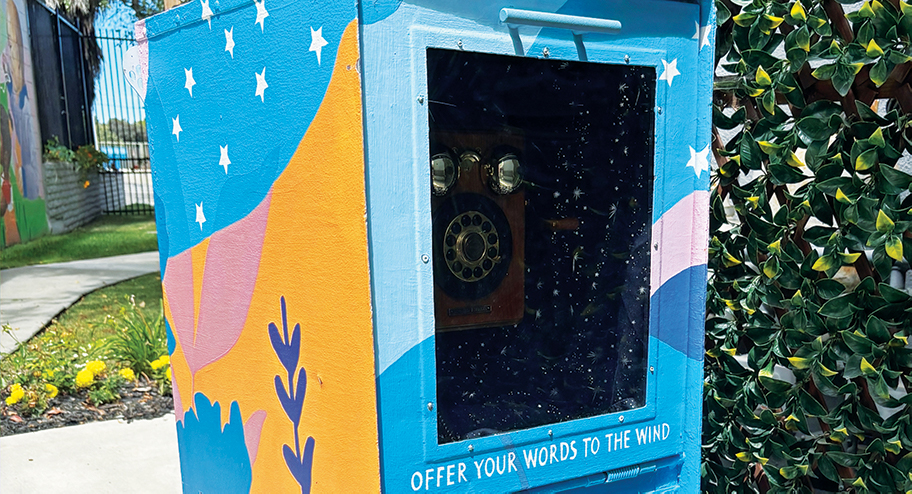
MONTEREY COUNTY — There is an old rotary telephone in a garden in downtown Salinas that will never ring. It isn’t connected to a phone line. There is no dial tone, and no one will answer when the receiver is lifted.
Still, people come to use it.
They dial the numbers of loved ones they have lost and talk. They may share something that happened that day, ask a question, say goodbye or simply speak the words they never had the chance to say.
The Wind Phone is part of the Papillon Center for Loss & Transition’s work to help Monterey County residents navigate grief. During National Grief Awareness Month in August, the organization is highlighting the phone and the broader community of people helping others through loss.
The idea originated in Japan, where Itaru Sasaki installed a disconnected telephone in a garden after losing his cousin. Following the 2011 tsunami, others began using the phone to speak to loved ones who had died, and Wind Phones have since appeared in communities around the world.
Salinas’ phone is housed in a vintage newsstand donated by Monterey County Weekly. The project was supported by the Arts Council for Monterey County and features artwork created by local artists Paul Richmond and Briden Schueren.
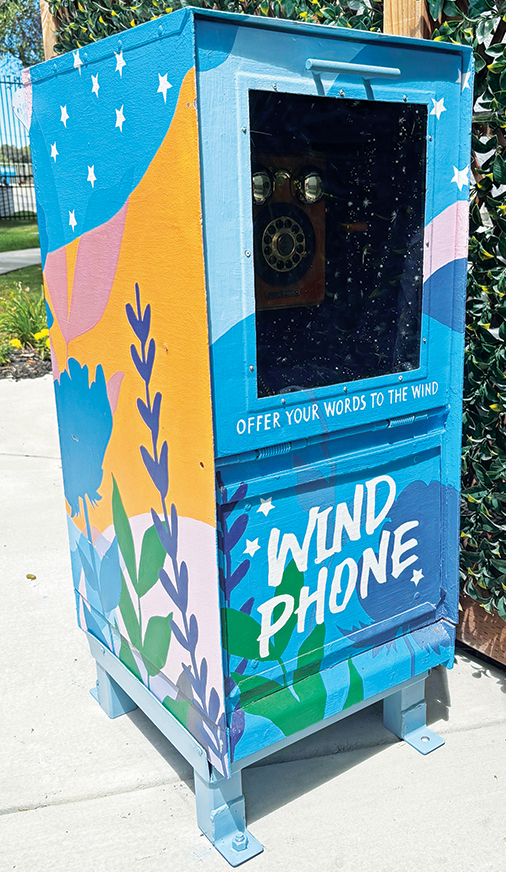
A second Wind Phone is located at Saint Dunstan’s Episcopal Church in Carmel Valley, with a third planned at the Veterans Transition Center in Marina and additional locations potentially coming to other communities in Monterey County.
For Joy Smith, who co-founded Papillon in 2013, the appeal of the phones is rooted in something much bigger: giving people permission to acknowledge loss.
“Every one of us is dealing with loss every day. Loss of health. Loss of energy. Loss of the life we thought we would have. We are rewarded for achieving and acquiring, not for losing — so when loss arrives, we simply don’t have the language to talk about it. We are, as a culture, largely illiterate about grief,” Smith said.
Smith’s own work as a palliative medicine nurse educator exposed her to grief regularly. Papillon, which later merged with Coastal Kids Home Care, now offers free grief support for those experiencing a wide range of losses.
That support includes people like Chuck Obeso-Bradley, a Papillon Grief Companion who knows firsthand what it means to lose a child. He and his wife lost their son in 1986. After surviving cancer years later, he began mentoring other cancer patients, eventually meeting Smith.
Now he uses his experience to support others, including a family grieving the unexpected death of a child.
“So much of this is simply showing up and letting folks know they are not alone — and that time will make things better,” Obeso-Bradley said. “It is very rewarding when you can see your own story helping them.”
Papillon’s support also includes a Spanish Adult Grief Group facilitated by therapist Cristal Santana. The free group meets Saturdays and provides a place for Spanish-speaking participants to learn about grief and talk about their experiences.
“Listening to other members describe similar experiences reminds each person that although it may feel like they are alone — they are not alone,” Santana said. “Be kind to yourself. Grief is messy. Being kind to yourself means reminding yourself that you are doing the best you can in this moment.”
For information about Papillon’s grief services, call 1-800-214-5439 or visit papilloncenter.org.